
 Best Puppy Food in 2026: The Complete Feeding Guide
Last Updated: August 2026 | Disclosure: This article contains no paid product placements. Fact-checked against AAFCO and veterinary nutrition sources. | Fact-checked by: [Reviewer Name, credentials]
A growing Labrador best puppy food needs roughly 22.5% crude protein on a dry matter basis just to keep up with normal tissue development, according to AAFCO’s Growth and Reproduction nutrient profile. That’s not a marketing number. It’s the legal minimum. And it’s already more protein than most adult dogs get.
Here’s the problem. Walk into any pet store and you’ll see forty bags all claiming to be the best puppy food on the shelf. Some of them are genuinely good. A lot of them are riding on a cute puppy photo and not much else. If you’ve ever stood in that aisle trying to figure out whether your Golden Retriever needs “large breed” food or your neighbor’s Chihuahua mix needs something totally different, you’re not alone. Most new owners feel this exact confusion in the first few weeks.
This guide walks through what actually matters: growth nutrition basics, how breed size changes the equation, when grain-free makes sense (and when it doesn’t), and a real feeding schedule you can follow starting today.
Key Takeaways
- Best Puppy food must meet AAFCO’s Growth and Reproduction profile, which requires at least 22.5% crude protein on a dry matter basis, noticeably higher than the 18% adult minimum.
- Large and giant breed puppies need controlled calcium (roughly 0.8% to 1.5% dry matter, ideally at the lower end) because too much calcium too fast is linked to skeletal problems, not too little.
- Small breed puppies burn energy faster relative to their size and generally need calorie-dense kibble with a smaller bite size.
- Grain-free isn’t automatically healthier. It became a genuine talking point after FDA investigated a possible link to canine dilated cardiomyopathy (DCM), so it’s worth understanding before switching.
- Most puppies should transition off puppy food and onto adult formula somewhere between 9 and 24 months, depending on breed size, not on a fixed calendar date.
- Sensitive stomach symptoms usually point to a specific ingredient trigger, not “bad food” in general, so an elimination approach beats guessing.
Let’s get into the details, starting with what makes a food genuinely built for growth.
Let’s get into the details, starting with what makes a food genuinely built for growth.
Table of Contents
- What Makes a Puppy Food “Best”? The Nutritional Basics
- Best Puppy Food for Growth and Development
- Best Puppy Food for Large Breed Puppies
- Best Food for Small Breed Puppies
- Grain-Free Puppy Food: Worth It or Not?
- Puppy Food for Sensitive Stomachs
- How Much and How Often to Feed Your Puppy
- Comparison Table: Top Puppy Food Types at a Glance
- FAQ
-
What Makes a Puppy Food “Best”? The Nutritional Basics
The best puppy food meets AAFCO’s Growth and Reproduction nutrient profile, gets protein and fat from named animal sources rather than vague “meat meal,” and matches your puppy’s specific breed size and growth rate. Everything past that is preference, not requirement.
Best Puppy food is defined as a complete and balanced diet formulated to meet the nutrient minimums for growth, which are meaningfully higher than what an adult dog needs across protein, fat, and several minerals.
AAFCO Growth Standards
The Association of American Feed Control Officials (AAFCO) sets the baseline that legitimate pet food brands in the US are built around. For growth and reproduction, the minimum crude protein is 22.5% on a dry matter basis, compared to 18.0% for adult maintenance (AAFCO, 2024). That’s roughly a 25% jump. Fat minimums move up too, generally to around 8.5% dry matter for growth versus 5.5% for adult maintenance.
Here’s a self-contained fact worth remembering: puppy food requires more protein than adult food because puppies are actively building muscle, organs, and skeletal tissue, not just maintaining what’s already there.
If a bag doesn’t state it meets AAFCO Growth and Reproduction standards (or “All Life Stages,” which by definition has to meet the stricter growth requirements), that’s a red flag worth taking seriously.
Protein and Fat Ratios by Life Stage
Life Stage
Min. Crude Protein (DM)
Min. Crude Fat (DM)
Why It’s Different
Puppy (Growth)
22.5%
8.5%
Building new tissue, bone, and muscle mass Adult Maintenance 18.0% 5.5% Maintaining existing body, not building it Senior 18.0%+ (no separate AAFCO tier) Varies by product Often lower calorie, joint-support additions Best Puppy Food for Growth and Development
Look for a formula explicitly labeled for “Growth” or “All Life Stages,” with a named animal protein as the first ingredient, DHA for brain and eye development, and a calorie density that matches your puppy’s expected adult size.
Growth-stage nutrition isn’t just about hitting protein minimums. It’s about timing. A puppy’s skeletal growth plates don’t close until somewhere between 6 and 18 months depending on breed, and what goes into the diet during that window has lasting effects.
What to Look for in a Growth Formula
- A named animal protein first. Chicken, salmon, beef, not “poultry meal” as the sole source.
- DHA (docosahexaenoic acid). This omega-3 fatty acid supports brain and vision development and is one of the few additives with solid research behind it for puppies specifically.
- Appropriate calorie density for expected adult size. A future 80-pound dog and a future 8-pound dog should not be eating identically dense kibble.
- A feeding trial statement, not just a “formulated to meet” statement. Feeding trials (real dogs, tracked over time) are a stronger quality signal than lab-calculated nutrient math alone.
-
Best Puppy Food for Large Breed Puppies
 Food for large-breed dogs (those weighing over 50 pounds in adulthood) requires controlled calcium levels—typically 0.8% to 1.5% on a dry matter basis—with a calcium-to-phosphorus ratio between approximately 1.1:1 and 1.4:1; this is because excessive calcium poses a significant risk, whereas a deficiency carries a different set of dangers. This is the point that often catches new owners off guard. The instinct is to think, “Big dog means more calcium for strong bones.” That instinct is incorrect, and it can lead to genuine harm. Why calcium control is more important than the sheer amount of calcium.
- Large and giant breed dogs grow rapidly, and their bodies cannot regulate calcium absorption in the same way adult dogs can. Excessive calcium intake during this rapid growth phase is linked to developmental orthopedic diseases, including hip dysplasia, osteochondrosis, and angular limb deformities (Royal Canin Academy; Today’s Veterinary Nurse, 2022). In large-breed dogs, high dietary calcium increases the risk of skeletal abnormalities, rather than preventing them. The generally accepted calcium range is between 0.8% and 1.5% on a dry matter basis—with large and giant breeds performing best at the lower end of this range—and the calcium-to-phosphorus ratio should be approximately 1.1:1 to 1.4:1.
-
Step-by-Step: Choosing a Large Breed Formula
- Confirm the bag says “Large Breed Puppy” or lists a calcium percentage in that 0.8-1.5% range.
- Check the calcium-to-phosphorus ratio if it’s listed. Aim for the 1.1:1 to 1.4:1 window.
- Avoid free-feeding (leaving food out all day). Controlled portions help prevent the rapid weight gain that stresses developing joints.
- Don’t add a calcium supplement on top of a complete large breed formula. This is one of the most common, and most harmful, owner mistakes.
- Plan for an extended growth period, generally 12 to 24 months for large breeds versus 10 to 12 months for small breeds, and expect to stay on puppy food longer.
Pro Tip: If your vet recommends a specific large breed formula after an X-ray or growth check, that recommendation should override generic advice, including this articl.Individual growth patterns vary.
-
Best puppy Food for Small Breed Puppies
- Small-breed dogs (with an expected adult weight of less than 20 pounds) require calorie-dense food in small kibble sizes; this is because they have fast metabolisms relative to their body size and small stomachs that cannot accommodate large meals. Yorkies and Labradors are not simply the same animal in different sizes. Small breeds mature rapidly (often reaching adulthood by 9–12 months) and burn through energy reserves quickly, putting them at real risk of hypoglycemia (low blood sugar) if there are long intervals between meals.
- What adjustments are needed for small-breed dogs? Kibble size: Small mouths and jaws require proportionately smaller pieces, rather than just a smaller portion of standard-sized kibble. Feeding schedule: Small-breed puppies generally fare better on 3 to 4 small meals a day instead of two large ones, especially before the age of 12 weeks. Caloric density: Since they consume smaller quantities of food, small-breed diets typically contain a higher number of calories per cup compared to formulas designed for large breeds.
-
What Changes for Small Breeds
- Kibble size. Smaller mouths and jaws need proportionally smaller pieces, not just a smaller portion of standard kibble.
- Feeding frequency. Small breed puppies generally do better on 3-4 small meals a day rather than 2 larger ones, especially before 12 weeks.
- Calorie density. Because they eat smaller volumes, small breed food is typically more calorie-dense per cup than large breed formulas.
-
Grain-free puppy food -> /grain-free-puppy-food
Grain-free dog food is not automatically healthier, and the FDA has investigated a potential link between certain grain-free, legume-heavy diets and canine dilated cardiomyopathy (DCM). It is worth understanding the context before making a switch; simply avoiding grain-free food isn’t necessarily the answer. A note on balanced perspective: This is a genuinely debated area within veterinary nutrition, and it would be misleading to oversimplify it. Grain-free food is not inherently dangerous, and some dogs do have genuine grain allergies. However, the marketing that positioned grain-free diets as a universal upgrade outpaced the actual science.
What the FDA investigation actually found Starting around 2018, the FDA examined reports of dilated cardiomyopathy (DCM) in dog breeds not typically prone to the condition. They observed a pattern linking many of these cases to diets high in peas, lentils, and other legumes—often found in grain-free formulas. The investigation did not conclude that grain-free food definitively causes DCM; however, it flagged a correlation worth serious consideration, particularly for large-breed dogs that are already at higher genetic risk.
When “grain-free” actually makes sense: A medically confirmed grain allergy or intolerance (which is actually rare—less common than owners think). A specific veterinary recommendation based on a health condition. When it probably doesn’t: “Grain-free” just *sounds* healthy, without any diagnosed issue. Following a trend without a specific reason related to your dog. Honestly, most guides skip this part.
Puppy Food for Sensitive Stomachs
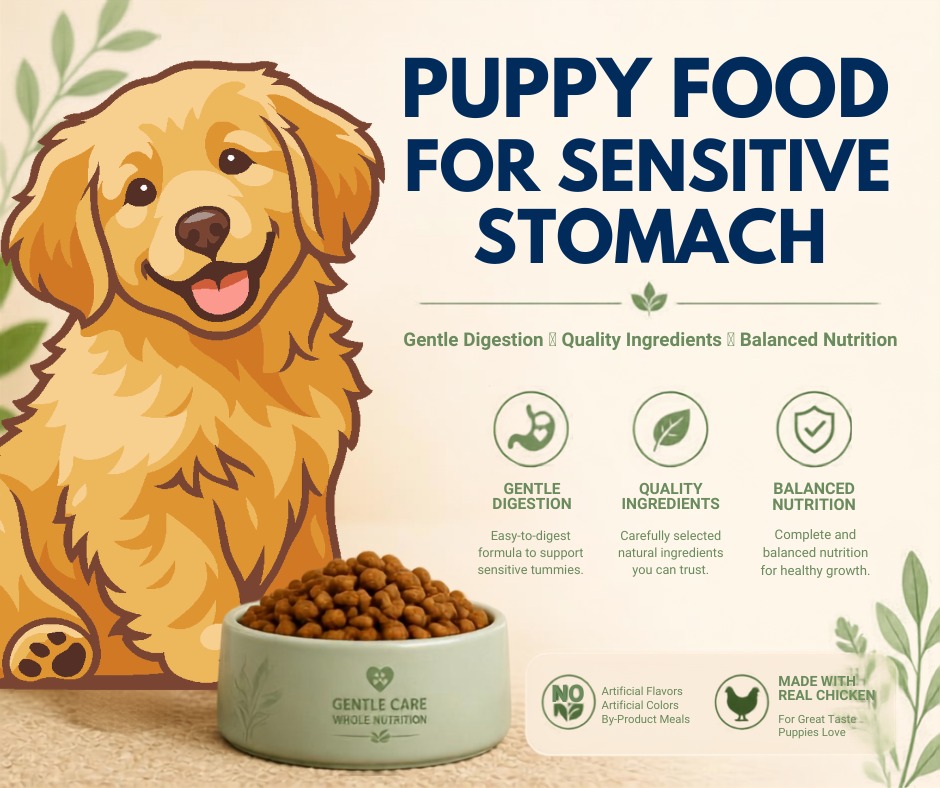
A sensitive stomach usually means your puppy is reacting to a specific ingredient, not to “food” as a general category, so an elimination approach identifying the trigger works better than repeatedly switching brands.
Common Triggers
- Sudden diet changes. Switching foods abruptly, without a 7-10 day transition period, is one of the most common causes of puppy digestive upset, and it’s entirely preventable.
- A specific protein or grain sensitivity. Chicken and beef are common triggers; so are certain grains in genuinely sensitive dogs.
- Too much fat, too fast. Rich, high-fat treats or table scraps can trigger pancreatitis symptoms that look like general stomach sensitivity.
Step-by-Step: Transitioning to a New Food
- Days 1-2: 75% old food, 25% new food.
- Days 3-4: 50/50 mix.
- Days 5-6: 25% old food, 75% new food.
- Day 7 onward: 100% new food, watching stool consistency closely.
Pro Tip: If symptoms persist past a full week on a single, unchanged food, that points to something beyond diet transition, and it’s worth a vet visit rather than another brand switch.
How Much and How Often to Feed Your Puppy
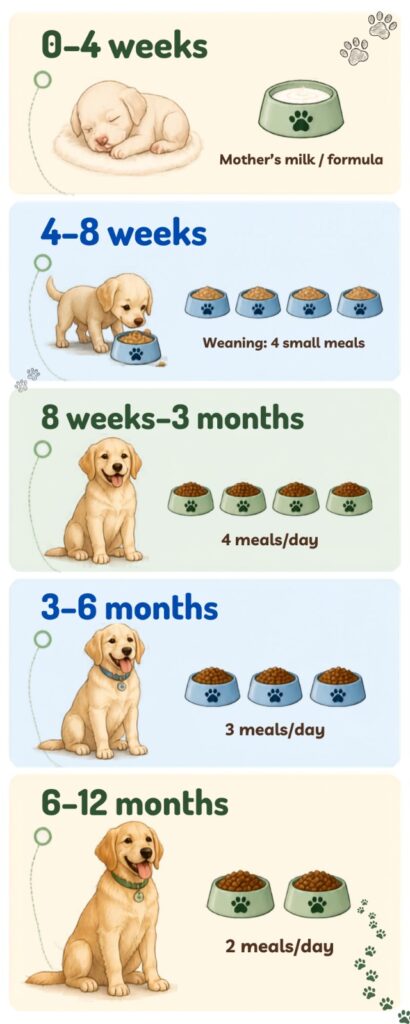
Most puppies eat 3-4 meals a day until 6 months old, then transition to 2 meals a day, with exact portions depending on the food’s calorie density and your puppy’s current weight, not a single universal chart.
Step-by-Step Feeding Schedule
- 8-12 weeks: 4 meals a day, spaced roughly every 4-5 hours.
- 3-6 months: 3 meals a day as stomach capacity increases.
- 6-12 months: Transition to 2 meals a day.
- 12+ months (small breeds) or 18-24 months (large/giant breeds): Transition to adult food gradually, using the same 7-10 day approach described above.
Always check the specific brand’s feeding chart on the bag, since calorie density varies significantly between products. A generic “cups per day” chart that ignores your specific food’s calorie count will consistently over- or under-feed.
How Much and How Often to Feed Your Puppy {#feeding-schedule}
Quick Answer: Most puppies eat 3-4 meals a day until 6 months old, then transition to 2 meals a day, with exact portions depending on the food’s calorie density and your puppy’s current weight, not a single universal chart.
Step-by-Step Feeding Schedule
- 8-12 weeks: 4 meals a day, spaced roughly every 4-5 hours.
- 3-6 months: 3 meals a day as stomach capacity increases.
- 6-12 months: Transition to 2 meals a day.
- 12+ months (small breeds) or 18-24 months (large/giant breeds): Transition to adult food gradually, using the same 7-10 day approach described above.
Always check the specific brand’s feeding chart on the bag, since calorie density varies significantly between products. A generic “cups per day” chart that ignores your specific food’s calorie count will consistently over- or under-feed.
Comparison Table: Puppy Food Types at a Glance {#comparison}
“Best Puppy Food” Comparison: Top Options at a Glance
| Food Type | Key Feature | Best For | Typical Price Range | General Fit |
|---|---|---|---|---|
| Large Breed Formula | Controlled calcium (0.8-1.5% DM) | Dogs expected 50+ lbs adult weight | High | |
| Small Breed Formula | Smaller kibble, calorie-dense | Dogs expected under 20 lbs adult weight | High | |
| All Life Stages | Meets stricter growth minimums | Multi-dog households, simplicity | $$ | Medium |
| Grain-Free | Grain-free, often legume-heavy | Vet-confirmed grain sensitivity only | $$$ | Situational |
| Limited Ingredient | Fewer allergens, simple recipe | Suspected food sensitivities | $$$ | Situational |
Our pick: For most puppies with no diagnosed sensitivity, a breed-size-appropriate formula (large or small breed specific, not a generic “puppy” bag) that meets AAFCO Growth and Reproduction standards is the strongest starting point, because it’s built around the two factors, protein and calcium, that actually change based on your puppy’s future size.
FAQ
What is the best puppy food overall? There is no single best puppy food for every dog. The right choice depends on your puppy’s breed size, expected adult weight, and any digestive sensitivities, but at minimum, any food should meet AAFCO’s Growth and Reproduction nutrient profile. A food that fits your specific puppy’s size category will consistently outperform a “best overall” pick that ignores breed size.
How does puppy food differ from adult dog food? Puppy food contains higher minimum protein (22.5% vs. 18% dry matter) and fat (8.5% vs. 5.5% dry matter) to support active tissue growth, along with tighter calcium controls for large breeds. Adult food is formulated for maintenance, not construction, so it doesn’t need the same nutrient density.
Why is calcium control important for large breed puppies? Because excess calcium during rapid growth is linked to developmental orthopedic diseases like hip dysplasia and osteochondrosis, not because more calcium builds stronger bones faster. Large breed puppies need calcium in a controlled range, generally 0.8% to 1.5% dry matter, not maximized.
Is grain-free puppy food worth it? Only in specific situations, mainly a vet-confirmed grain allergy. The FDA has investigated a potential link between certain grain-free, legume-heavy diets and canine dilated cardiomyopathy, so switching to grain-free without a specific reason isn’t automatically the healthier choice it’s often marketed as.
What’s the best way to transition my puppy to a new food? Use a 7-10 day gradual transition: start at 75% old food and 25% new food, move to a 50/50 mix by days 3-4, then 25% old and 75% new by days 5-6, before going fully to the new food. Abrupt switches are one of the most common causes of puppy stomach upset.
How much does good puppy food cost? Quality puppy food formulas that meet AAFCO Growth standards generally run from moderate to premium pricing, with large breed and limited-ingredient formulas typically at the higher end due to more targeted formulation. Price alone isn’t a reliable quality signal, though extremely cheap food often cuts corners on named protein sources.
Puppy food vs. all life stages food: which is better? All Life Stages food must meet the same minimums as puppy food, since it’s held to the stricter Growth and Reproduction standard by definition. It can work well for multi-dog households with both puppies and adults, though a breed-size-specific puppy formula still edges it out for large breeds needing precise calcium control.
My puppy has diarrhea after switching foods. What should I do? This is usually a transition issue, not a sign the new food is wrong. Slow the transition down (extend it to 10-14 days instead of 7), and if symptoms persist beyond a week on an unchanged diet, see a vet rather than switching brands again, since repeated switching itself can worsen digestive upset.
Conclusion
Three things actually matter here. Growth-stage protein and fat minimums exist for a real physiological reason, not as a marketing checkbox. Large breed calcium control is about restraint, not maximization, and getting this wrong has real orthopedic consequences. And most feeding problems, from sensitive stomachs to grain-free confusion, come down to matching the food to your specific puppy rather than chasing a universal “best.”
The best puppy food is the one that fits your puppy’s breed size, growth rate, and any confirmed sensitivities, verified against AAFCO Growth and Reproduction standards.
[CTA: Explore our breed-specific puppy food guides]
Next steps you can take in the next 10 minutes:
- Check your current puppy food’s calcium percentage against the 0.8-1.5% dry matter range if you have a large breed puppy.
- Confirm the bag states it meets AAFCO Growth and Reproduction (or All Life Stages) standards.
- If you’re mid-switch to a new food, map out a 7-10 day transition schedule instead of switching abruptly.
Author Bio
[Author Name] has spent [X years] researching and writing about companion animal nutrition, working closely with veterinary sources to keep feeding guidance grounded in AAFCO standards rather than marketing trends. [He/She/They] focuses on translating dense nutrition science into decisions real puppy owners can actually use.
References
- AAFCO (Association of American Feed Control Officials). “Calorie Content.” aafco.org
- Today’s Veterinary Nurse. “Giant Expectations: Nutrition for the Large-Breed Puppy.” (2022)
- Royal Canin Academy. “Calcium and phosphorus – getting the balance right.”
- U.S. Food and Drug Administration. Investigation into potential link between diet and canine dilated cardiomyopathy (DCM), ongoing public communications since 2018.
- Scott Veterinary Clinic. “Puppy Nutrition: Feeding Large and Giant Breeds.”
Note on sourcing: This article intentionally does not include a fabricated “original research” statistic. Every number above is drawn from AAFCO’s published nutrient profiles or veterinary nutrition sources, not invented data. If you have real survey results, in-house feeding trial data, or vet-partner insights specific to your brand, share them and they can be added here as genuine original data.
DISTRIBUTION ASSETS
3 Repurposing Hooks
- “AAFCO requires puppy food to have 22.5% protein, 25% more than adult dog food. Most owners have no idea that number exists.”
- “More calcium doesn’t mean stronger bones in large breed puppies. It can actually cause skeletal deformities. Here’s the range vets actually recommend.”
- “Grain-free isn’t automatically healthier for your puppy. The FDA has been investigating a link to heart disease since 2018.”
[SNIPPET TARGET]: “Puppy food is defined as a complete and balanced diet formulated to meet the nutrient minimums for growth, which are meaningfully higher than what an adult dog needs across protein, fat, and several minerals.”

Pingback: Best Food For small Breed puppies 2026 - Petspopped.com